October 12, 2026
She’s a statistics expert, and she works with BIRD data – what a great combination of technology and nature! Her inspiration for her personal style is this dapper creature:
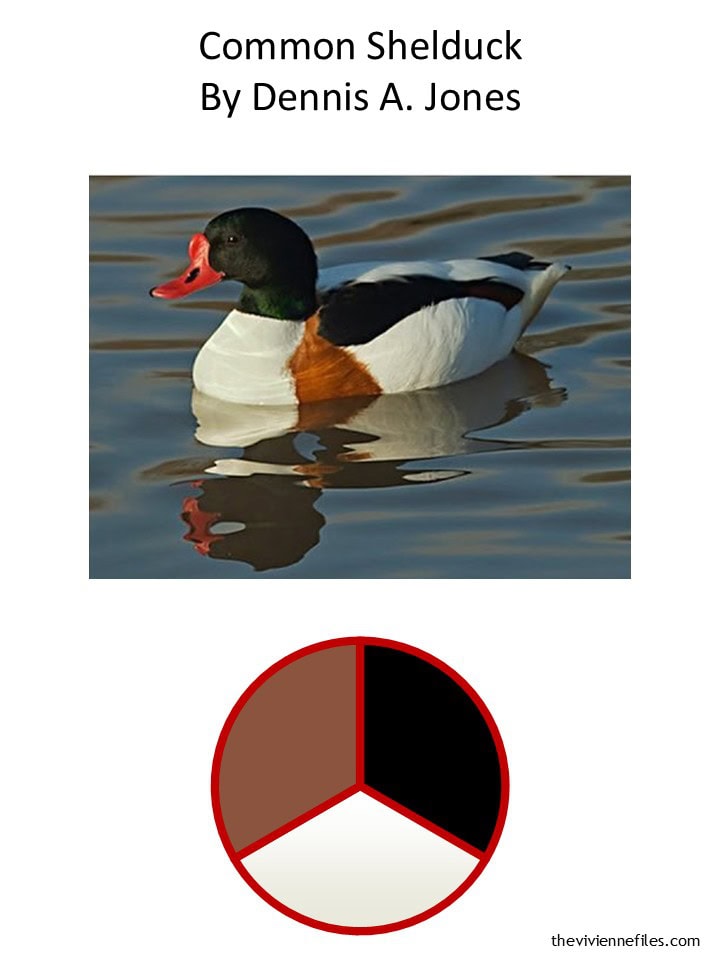
Going into full-tilt autumn, our heroine felt that she was relatively well prepared for most of what life had to offer:
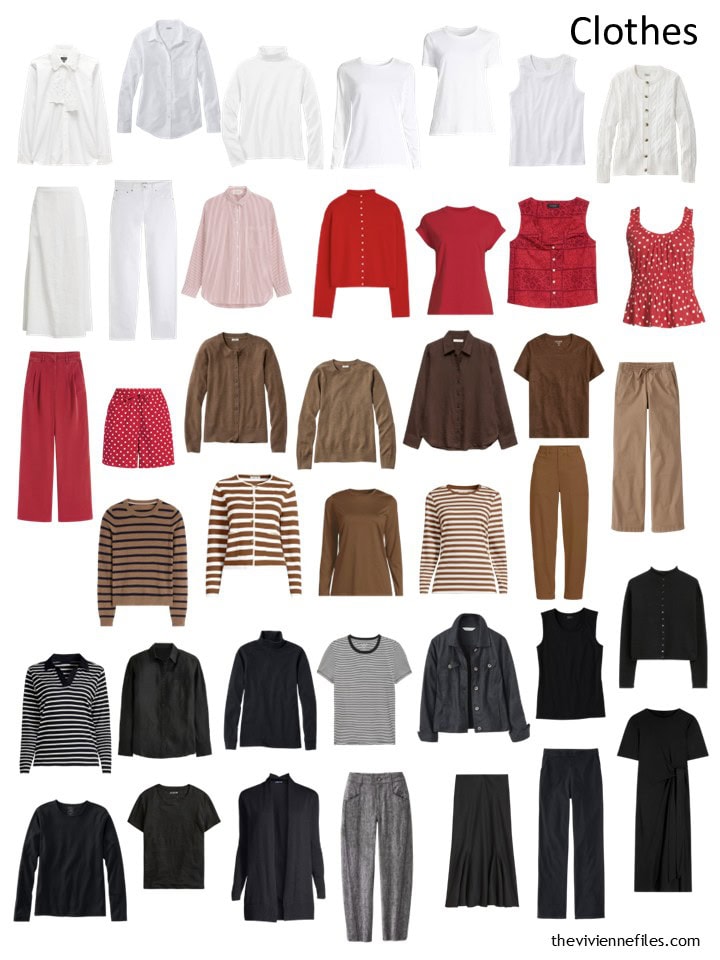
I have to share this with you: in the year of my birth, 1960, the average woman’s wardrobe (in the US) was 42 garments. That would be the wardrobe above plus two.
And when I really try to remember what I wore through high school and college (when I was not interested in clothes much at all!), I may have had this many pieces. But I don’t think so…
Now, the average wardrobe is OVER 150 things. What has changed so radically in 66 years? Your thoughts are of great interest to me, since I suspect that quite a few of us have lived through this transition!
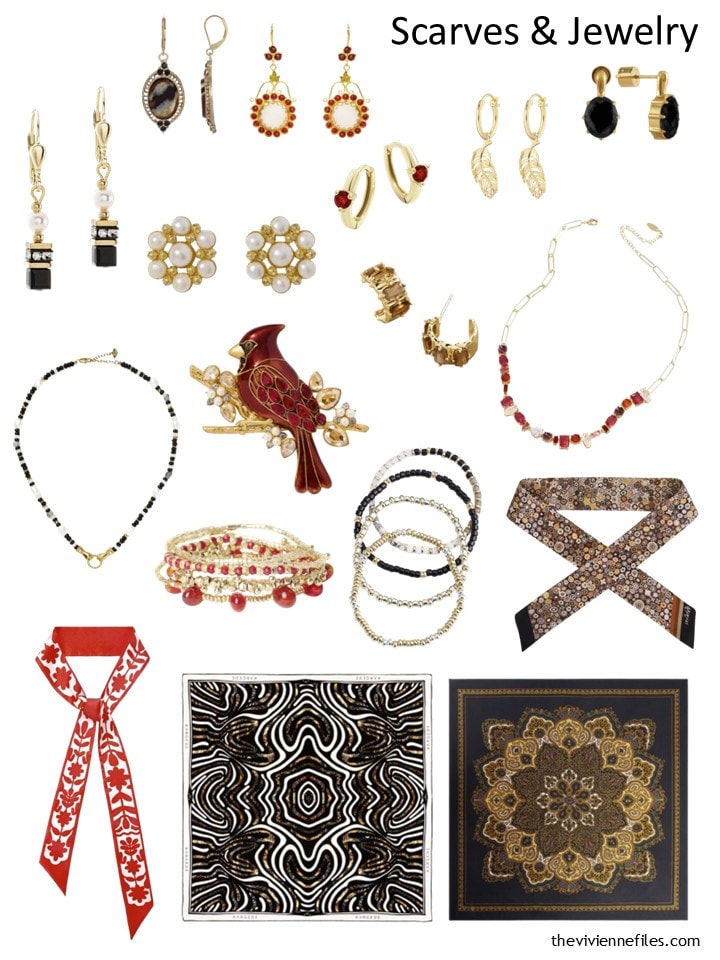
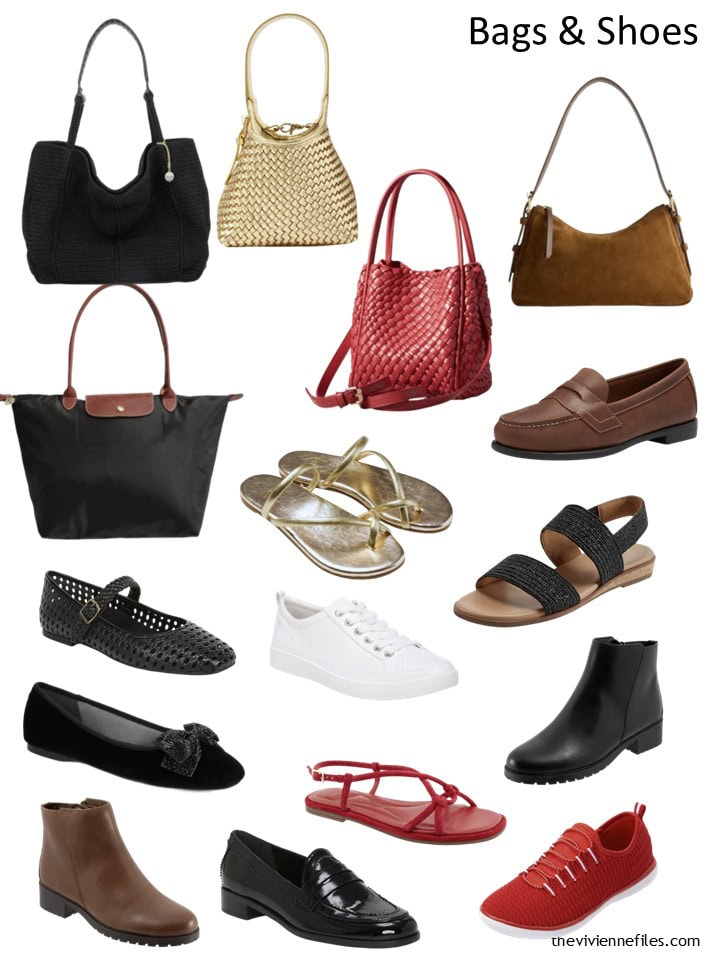
But on to our heroine’s accessories. I find the power of accessories to be astonishing:
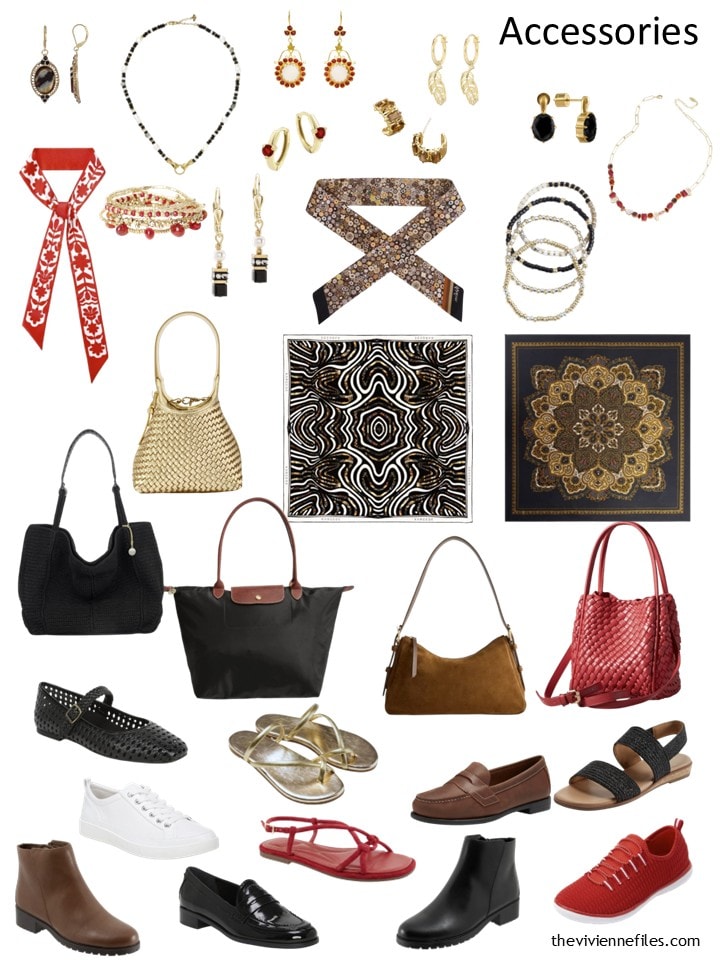
After returning from the Vermont college adventure of analyzing data from all kinds of new (to her) birds and meeting ALL kinds of bird people, our heroine is amazed to find that her “professional/social” calendar is filling up! She’s now a recognized expert in her field, and she’s welcome at all kinds of luncheons, cocktail parties, one-day conferences and the occasional small dinner party.
Thus, her shopping this month is dressy, with just a whisper of the upcoming winter holidays:
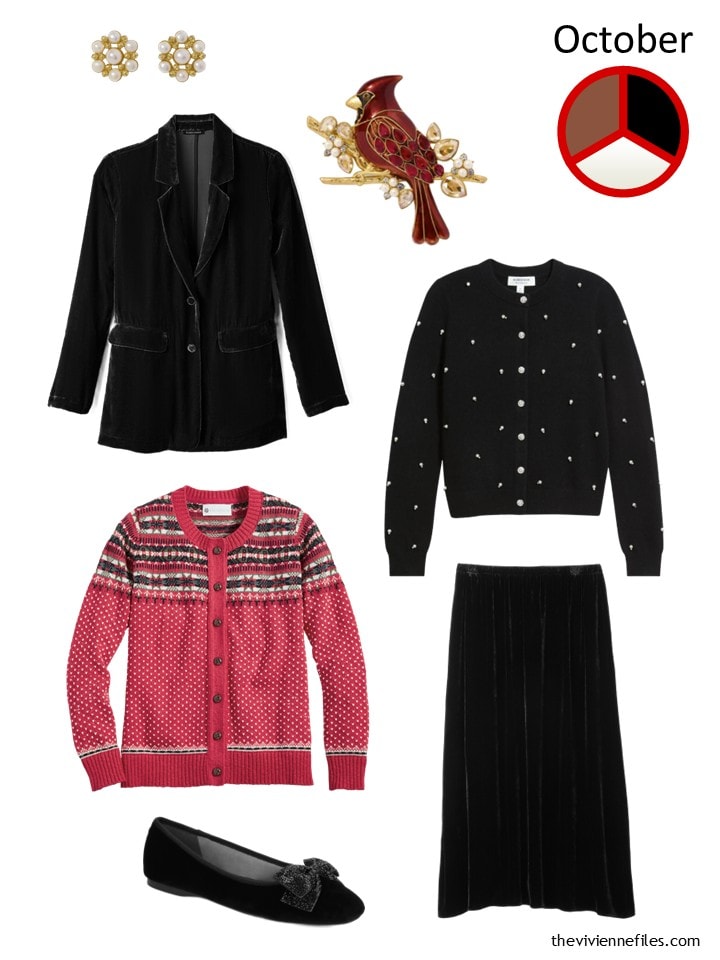
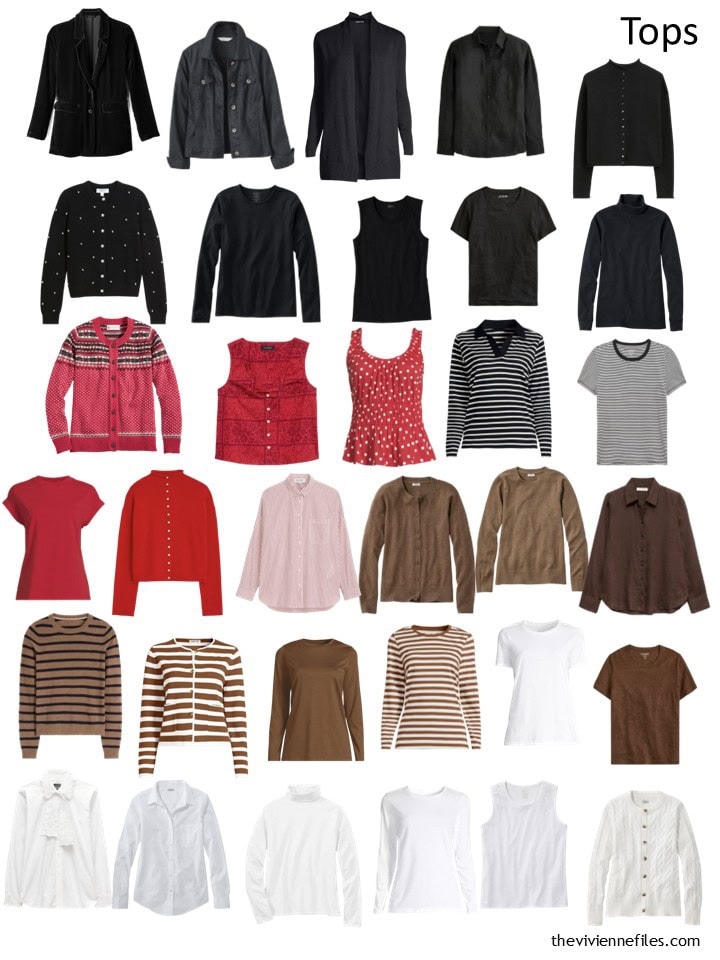
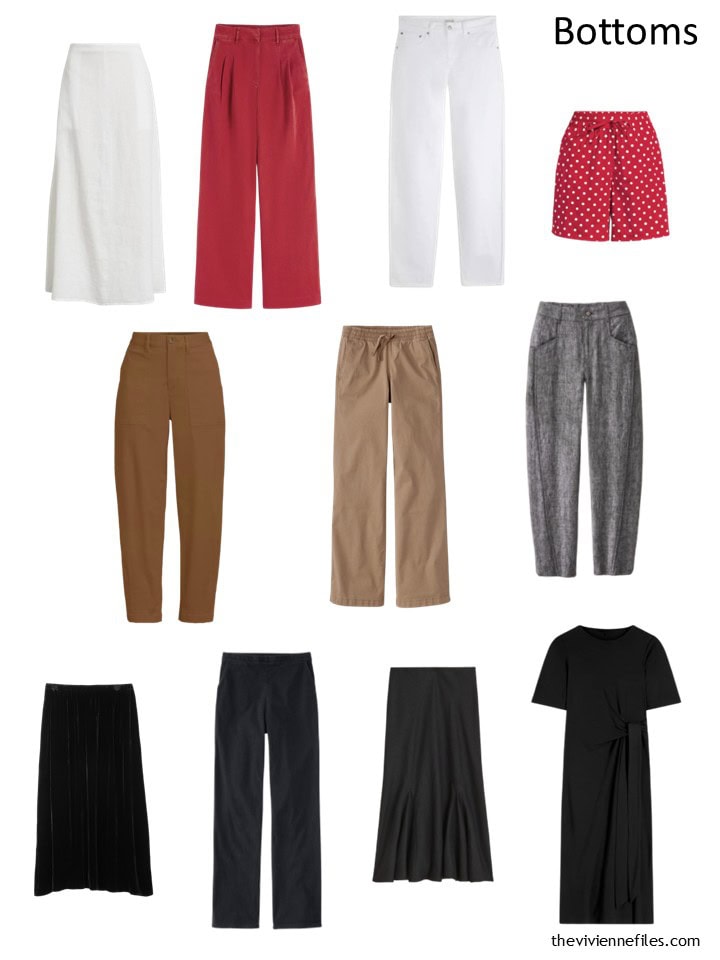
Earrings – The Met Store; black velvet blazer – Eileen Fisher; cardinal brooch – The Met Store; beaded cardigan – Nordstrom; cotton Fair Isle cardigan – Ella Simone; black velvet skirt – Eileen Fisher; velvet flats – Birdies
The bird brooch was intentional, buying flats from a company called Birdies was strictly a coincidence!
Now, when she fills in her wardrobe template, she has filled in those “2nd layer” spots and everything lines up perfectly!
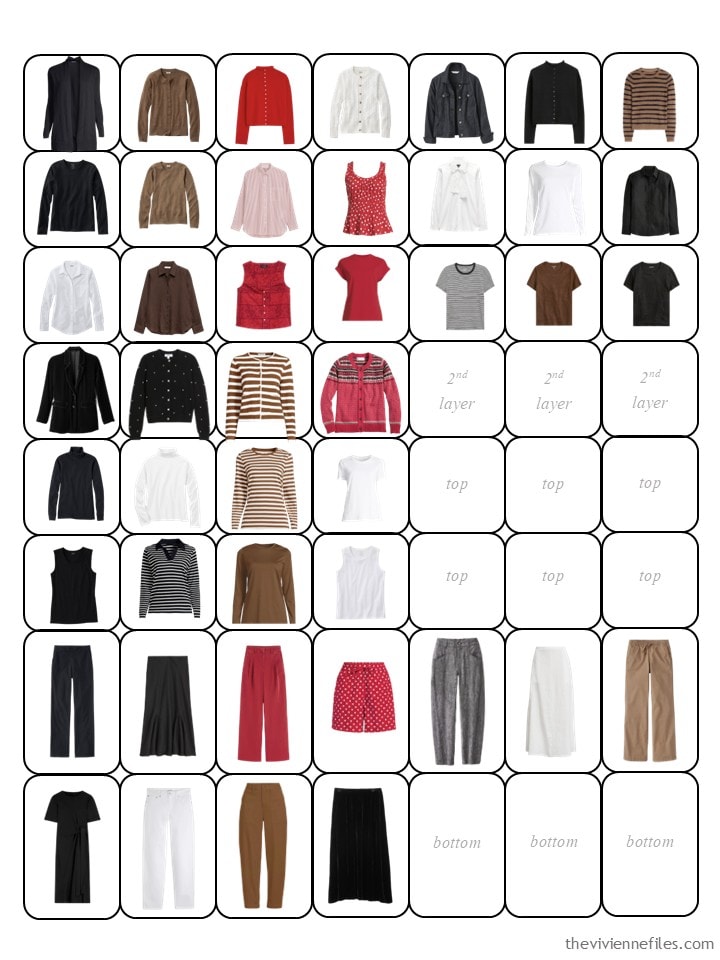
How does it look in her closet? Pretty delectable!
Her bird brooch brings a certain je ne sais quoi to her accessories!
Our heroine bought her velvet jacket and skirt without ANY intention of wearing them together – the jacket is just long enough that it’s going to hang down over the tops of the gathers of her skirt, and she knows it will look lumpy and draggy…
But that’s no reason NOT to buy two velvet garments! Everything doesn’t have to be worn in every possible combination; she has plenty of other ideas:
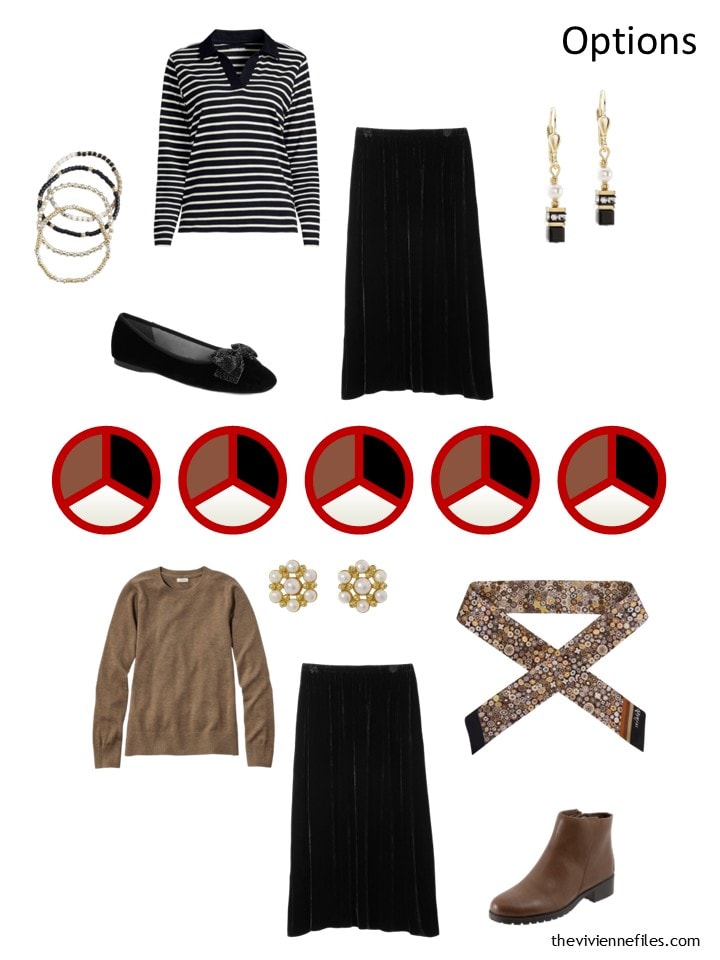
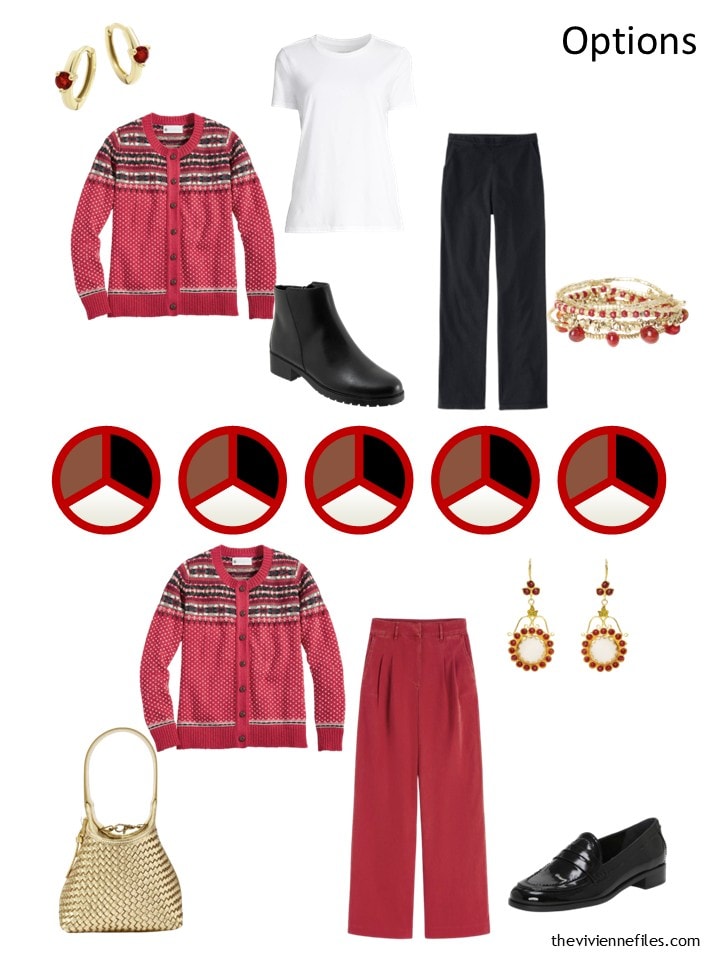
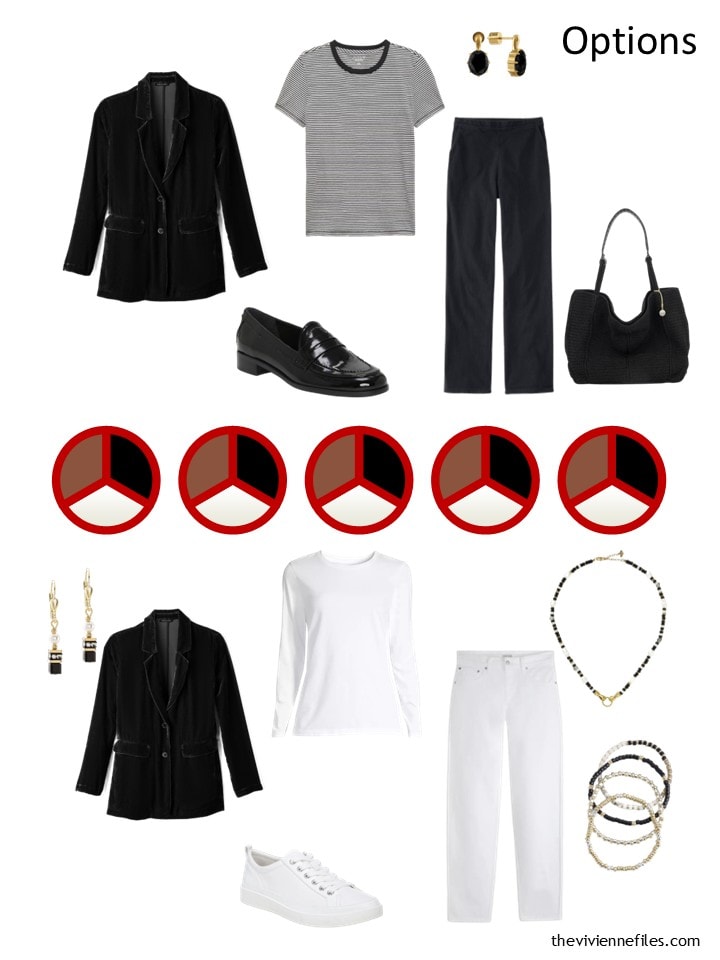
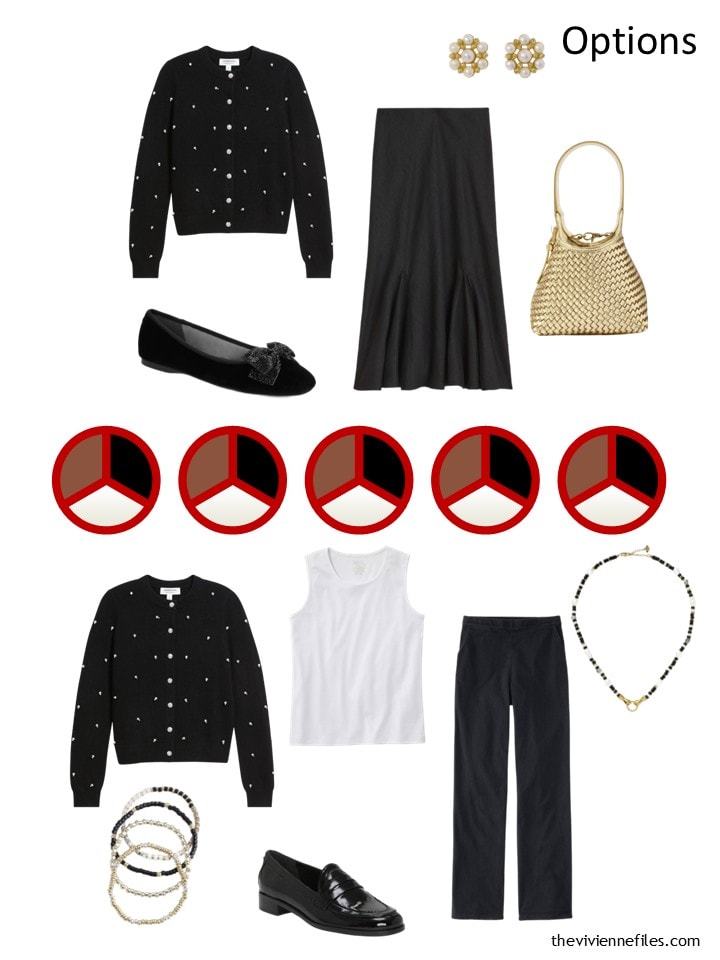
Some people get their holiday wardrobe in place really early, like this heroine. Others wait until the stores are jam-packed with beads and sequins before they start looking.
And some of us wear the same things we wore last year! And the year before…
love,
Janice
Would you be interested in “flashing back” to the earlier posts in which is heroine assembled her wardrobe? Those posts are here: Christmas Eve Preview, January, February, March, April, May, June, July, August, September
p.s. Ten years ago, we were almost finished building a wardrobe in navy, beige, pink and soft blue; in this post we added a complete outfit of a sweater, shirt and shorts!
p.p.s. If you’re shopping at a website that you don’t see in my links, but you would like to help support The Vivienne Files, check out this page, where I’ve put links to a lot of retailers with whom I have some kind of business relationship. I’m not going to get rich, but I can at least afford plenty of coffee!
October 2026 – Building a Wardrobe Starting With Common Shelduck by Dennis A. Jones
This is such a great wardrobe, even though it’s totally not my colours. And I love the new cardinal brooch. I’m not much of a brooch wearer, although I do have a nice little dragonfly pin. Perhaps it’s time to try it?
As to the number of items in our wardrobes – which I think is a really interesting issue to think about: I was born in 1955. Our lives/lifestyles have radically changed since then, and, perhaps equally or more significantly, so have our expectations.
I’ve been curating my own collection of clothes recently, so now, excluding underwear, nightwear, footwear and outerwear, I have just 49 pieces, which I discover is plenty – although knowing that doesn’t stop me from being tempted, at least in my imagination, by the lovely pieces you show us, Janice!
The question of wardrobe size is an interesting one. I suspect that it has a lot to do with changing norms in what is acceptable to wear. These days, people can wear a very wide variety of clothing and be considered appropriate, even to work. And yet there are still events that require more formal attire, so you can’t just forego one or the other. There’s also likely an impact from the influx of fast-fashion and the declining quality of pieces that are readily available. For instance, if I find pants that I like, I’ll buy several pairs, knowing that they will likely wear out in just a few years. Compare that to other pieces from high school that I still own and wear regularly. It makes me reticent to let go of clothing from years past, even if I don’t wear it frequently, because it’s made of nicer, thicker materials. I’m interested to hear what other readers suggest.
In the meantime, it’s a good reminder to go through the clothing I own with a more discerning eye and decide what really needs to stay with me.
Expectations and the cost of clothing. But perhaps also, for most of us normal people, we were not often being photographed. I have very few photos of what I wore to high school, which is a bit of a blessing, but yes, I know I did have fewer clothes then; and if I worry that I’m misremembering, I know I also had a very small closet.
Yes, being photographed. I have a 13-piece capsule wardrobe pulled from my closet that I pack twice a year for cruising. It is the same 13 items every time (blissfully easy packing). My sister does the exact opposite – she buys new items for every cruise. She can identify which vacation she was on (even which location or excursion) based on what she is wearing in the photos.
She is a seasoned bargain-shopper and thrift-shopper with the time and enthusiasm to shop, so the items are new to her, are not expensive, and she enjoys creating new outfits for each new adventure. When she returns, she donates the items to Goodwill and begins looking for items for her next cruise. Different approaches, one avoiding decision fatigue, one heavily influenced by being photographed and posting on social media. Even without social media, she would want new outfits every trip. It’s all part of extending her vacation fun.
You are right, Janice, this is a lot of beautiful clothes, but do we really need all of them. I was in high school in the 1960s when girls wore skirts, dresses, sweater sets but never pants to school. I had a couple of really nice quality kilts, a couple of pleated skirts and some blouses and sweater sets. Now in my late seventies I love fashion but have way too many clothes. I am seriously curating my wardrobe, keeping only what I love and donating the rest. Having lovely accessories that can elevate a few basic outfits is now my new way of dressing. I look forward to your posts to see what is current and they really help me make use of what I already own.❤️
Yikes! I have way too many things in every category! Have a hard time letting go of things-what if I need it or can’t find something I like? But yes-in high school i had very few clothes-could be why I hoard them now?
You pose a fascinating question regarding the increase in the number of garments women own today compared to what they owned in the past. My first thought was the rise of fast fashion and influencers (and hauls).
Fast fashion. When I was younger there were two seasonal collections (Summer and Winter). Now it seems there are myriad “micro” seasons. The opportunity to buy clothing is not limited to twice a year, but every day (if you desire). Shopping online makes it even easier.
Household Priorities and Budgets. Another factor may be that households prioritize clothing expenses differently today than they did in the past. When I was in my teens and 20’s, I had zero clothing budget. I wore clothing that were given to me by family and friends. I wasn’t poor, just a student with no clothing budget. I was so grateful to those people that helped me out at that time. Today I have a very healthy clothing budget to make up for those lean years. So spending on clothing has a higher priority in my household today.
Marketing. Marketing over the years has intensified. I have no idea what marketing was like in the past, but it seems so intense these days. There are subliminal and obvious tactics that are used to push product. I have to admit to having fallen prey to many of the tactics.
This is why The Vivienne Files was a breath of fresh air when I first found it. It examined and refuted many of the ideas I had come to believe when I was younger. When I first found TVF, I felt the retails store messaging was buy, buy, buy, buy. I am much more measured these days, but it took time for me to unlearn and relearn ideas.
Oh. One more factor. I used to have very limited categories of clothing: causal and sleep.
Today, I have dress, work, casual, gym, hiking, dancing, sleep, lounge. The only overlap is between lounge and sleep. So activities increased and required their own modules. This is a luxury. I could force my gym clothes to become hiking clothes, but I haven’t had to.
Re the topic of wardrobe size being so much larger now, I just did a quick count and have about sixty items, bulked up by quite a few tank tops. The only time I had loads of clothes was in the late Eighties when I was single and had lots of disposable income.
Great topic! Born in the 50s and raised to be frugal I always had few clothes until the past ten years. And like others mentioned often wished I had more. I think the greatest difference is online shopping. If I had to depend on what I buy locally I would have very few clothes. But discovering JJill has the most comfy well fitting jeans with clearance prices, I now have six pair of jeans in various colors. This after a lifetime of one or two pairs. I need to stop buying clothes! I think also thin out items I don’t love but am trying to wear out. I think I feel more comfortable with fewer clothes.
Love that brooch…I have way too many clothes, but I love them all lol. So why, well shopping has never been easier. Back in the 70’s you had no choice but to go downtown or to a mall to shop. Now I get emails constantly telling me about sales, discounts, new arrivals. With the internet, we can find items from Britain, Holland, Denmark, the world is at your fingertips if you have the money to spend. I am sure many of you have seen this advert from Amazon now telling you they can make you a personalized capsule wardrobe just for you; I wonder how many women will fall into that trap. Plus I agree with Debbie, I have spent good money and the quality is still poor. Just my observations on this subject.
I can’t imagine what those Amazon capsule wardrobes must be like – no garment that costs over $30??? That doesn’t sound like enduring, classic quality to me!
hugs,
Janice
In addition to the factors already identified for the increase in wardrobe size (I agree that these all made a difference!):
It’s good to remember that just because something was the norm in the past doesn’t make it the ideal, then or now. In high school (late 80s/early 90s), I couldn’t afford to buy many clothes. In college, both the expense and the very, very limited closet size in the dorms were a factor. When I lived with my parents for a couple years after college and started my first real job, I started thrifting and had a decent sized closet, so my wardrobe expanded. I then lived in a couple different apartments with, again, small closets (I had to buy a separate covered clothes rack to hang my work clothes). When I finally got into a modern apartment with more closet space, my wardrobe expanded. I value variety, so I would have been disappointed with a 42 item wardrobe back in 1960, no matter how nice the individual pieces were.
I bet if we compared average number of just about any category of possession then versus now, we would have a larger number now. Stuff gets relatively cheaper, people buy more – I’m not endorsing that for every category, but it’s a pretty standard phenomenon.
My dad likes to say “Stuff expands to fit the available space.” With larger apartments and houses so common now (my place is about 1500 square feet including the balcony, and it feels large to me, but it’s significantly lower than the US existing home average of 1,800 sq ft and new construction home average of 2,200-2,400 sq ft), and family sizes smaller than ever, that leaves a LOT of space to fill with stuff! And we are filling it.
What’s odd to me, a bit, is how readily we (as a society) have decided to forgo quality for quantity across the board (with the exception of things like electronics, cars, etc. that have improved in many ways due to tech advances). It sure can feel like we have gone way too far in this direction.
When thinking about the impact of price, it’s interesting to consider how the percentage of household budget spent on clothing has plummeted over time in the US. From 14% in 1900, 12% in 1920, 10% in 1960, 5.5% in 1980, 4% in 2000, and under 3% in 2020. I read that at the turn of the 19th century, clothing was the third biggest household expense after food and shelter! What a different world the past was. Obviously the clothing of today barely resembles clothing of the past (occasionally for good, often for bad), but it kind of makes sense that people treat clothing as disposable given how little of their money they spend on it.
It’s kind of strange that people buy more items than ever but also pay less than ever, not just for individual pieces but their wardrobes overall. Average yearly spending on clothing per person (in 2026 dollars) was $1700 in the 1960s, hit its peak at $2000 in the 1970s, then started decreasing: $1600 in the 1980s, $1400 in the 2000s, $1000 in the 2010s, under $800 now.
To put this in context, we spend $800 a year on things like home internet, air-conditioning for our homes (in warmer parts of the country), video and music streaming, alcohol, pet wellness care, entertainment equipment like TVs and gaming consoles.
Another weird thing is that I keep seeing clothing that is priced at higher price points that do not at all have the quality that the price suggests. There appear to be a million new clothing brands setting up every week like this. It’s like cheap clothing is going to be lower quality – OK, I understand that – but also expensive clothing is ALSO often lower quality. Has the correlation between price and quality gotten lower over time? This seems likely to get worse as younger generations of women are now using TikTok and the like as a dominant shopping venue and do not have much if any education on what makes something a quality garment. The current ease of shopping phenomenon is definitely a two-sided sword.
I personally would love to have higher quality items from when I was younger still in my closet, but those clothes would not come close to fitting me now. If you have managed to maintain your size/shape from your 20s into your 50s and beyond, hat’s off to you, but I think you’re in the minority. And given how unforgiving much of the clothing from the 1990s and earlier were (in terms of being structured with zero stretch), I’m guessing a lot of people have outgrown them.
On a semi-related note: I do notice in myself that I can readily balk at spending an amount of money on something now that would have felt quite normal in 1990 (in real dollar terms). Am I just anchored on the lower price points and can’t get over it? Do I feel uneasy about the longevity of a pricier piece so I doubt whether it will be worth it (due to quality concerns but also due to having experiencing so many changes in size over the years)? Am I reacting at some level to the uncertainty in the world and not willing to commit? I’m currently in a “not buying clothes” period so it’s not like I’m buying cheaper clothes instead, but I’m curious where I’ll find myself when it feels time to buy clothes again.
I just think accessability (even fast fashion) and attainability are large factors. We can go anywhere physically, or online, and buy whatever is advertised to us across all of the media we are exposed to. We have houses with bigger closets that need to be filled. Can we wear the same outfit all the time in all of the pictures we’re in? I know I am personally not at my wardrobe saturation point and I am cautiously selecting clothing more and more. This is interesting to me so thank you for posing it. Always enjoy your Files, Janice!
I’ve noticed everyone is comparing their teen wardrobes from the 60s to their adult wardrobes now. I know I have many more clothes currently because I have accumulated and kept things over the years. I don’t actually find much of my clothing wears out, which is a different experience than many people seem to have. So I’ve ended up with a lot of pieces overall.
Plus dopamine fuels easy shopping. Love the cardinal!
Oh, I love that brooch too. 😍
In our family and among friends, clothes have always been
and still are
swapped and passed on.
I actually counted once and have about 200 items of clothing (I used to have far fewer, though).
A lot of them are secondhand, and some are even 30 years old.
But I find it hard to part with things…
1956 here. Growing up, I had five school outfits, two Sunday dresses, and some play clothes. We went downtown in August to get me set for the school year and again before Easter for spring/summer/early fall outfits. My mother was a strict “outfit” person – when my cousin showed 10-year-old me how to mix and match her short sets my mother nearly lost her mind.
I went down south to college and took five skirt and blouse outfits, a pair of jeans, and a couple of sweaters. Once there, I bought five wool “College Town” skirts and blazers and began the joy of mixing and matching. I’m still an outfit person at heart, though, and I have a lot of clothes. Partially because I love color, but mostly because my weight fluctuates a lot and I’ve learned not to donate all of the clothes I’ve either shrunk or grown out of. I work in a public library and thus have easy care/easy wear clothes, rather than the investment pieces of my corporate life.
Oh this brings back memories! I look at how much stuff kids take to college today, and I’m stunned. I took one big suitcase, one box of bedding, and myself! No television, no furniture, no curtains, no beanbag chairs… What a simple life we had!
hugs,
Janice
This is a wonderful post. Shellduck is my favorite of this year’s pairings and it inspired me when i was packing for my daughter’s wedding last weekend. Other than the gowns I wore to events, I wore black, white, red and camel/leopard. It made this aspect of my trip a breeze, because I didn’t have to worry about pieces going together. Jenna Lyons, the former head of J. Crew, once said that leopard is her favorite neutral. I have to agree…I can see it easily fitting in with these beautiful pieces here.
Also, I’m one of lunatics who has a lot of clothes. I love fashion. I love clothes. I love making outfits. Project Runway is my Superbowl. When I built my new house, I took out and reconfigured one room and created my dream closet, which is room sized. I have it organized by type of clothing and clothing, so it looks a bit like a boutique. I completely realize that this is not for everyone. I respect that. But for those of us for whom style is a hobby, I do say ‘why not’? It’s okay to have lots of clothes if you have the resources….there is nothing wrong with it. Where it gets in the weeds for me is when people shop to the point of going into debt….it isn’t necessary to be broke and not have grocery money. However, if you shop intelligently, it’s all good in my book. I don’t want to be judged, so I’m very careful not to judge others, about this.
One rule I do try to follow is that, if I buy something new, something old needs to be donated.